
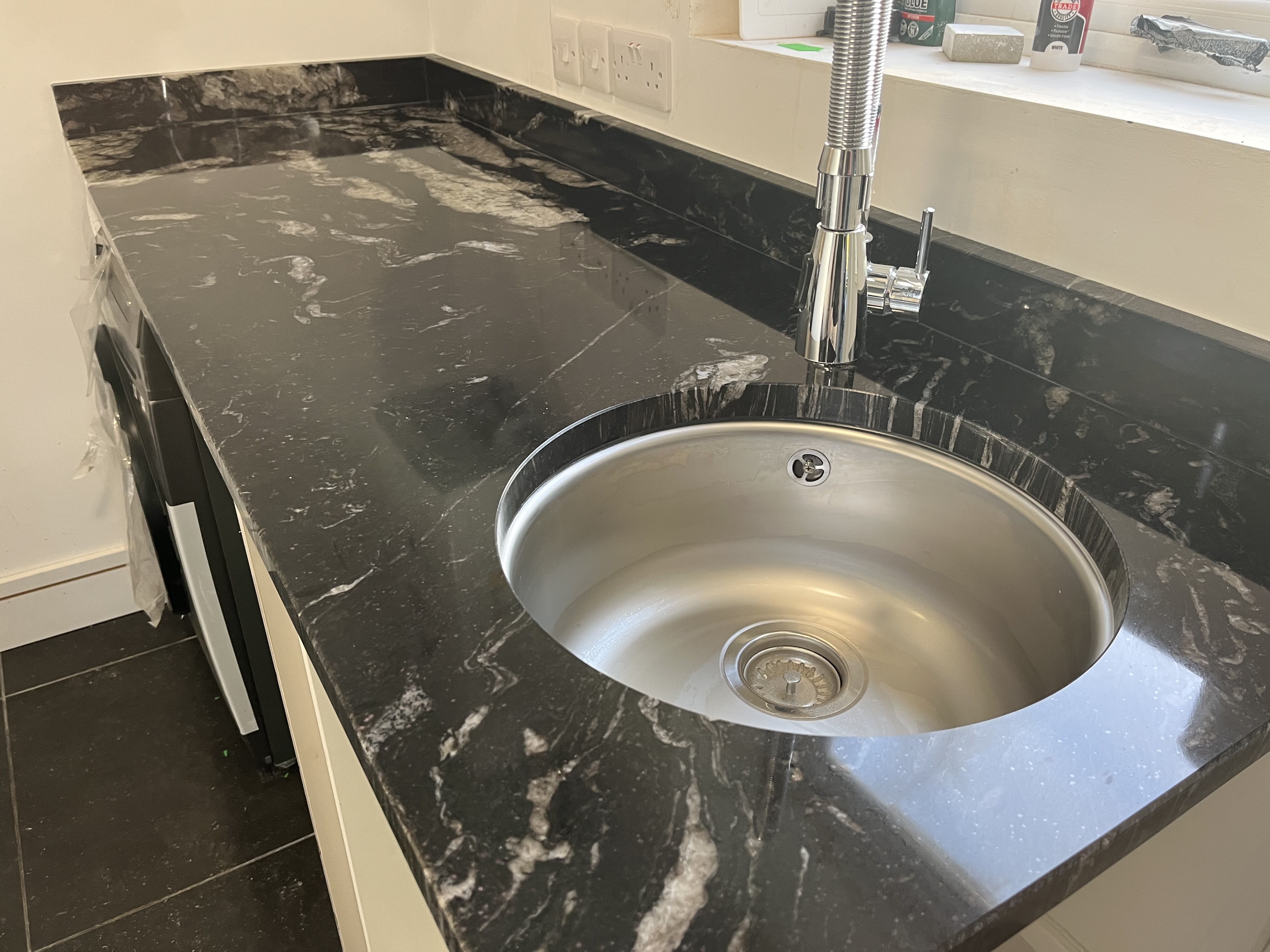
Natural Black granite Utility worktop with under mounted Sink.
worktoprepair.com received a phone call last week from a customer reporting a crack in their granite worktop in the utility area of their home. A decorator had stood on the worktop at the corner I went to inspect, and the granite was cracked from the corner extending to the sink area. The reason for the worktop cracking was insufficient support underneath at the corner. Always be aware that when having a sink cutout in granite at a corner, there may not be enough support for the worktop. That said, the granite worktop should not have been stood on at the corner, so the poor decorator received a bill from me to repair it rather than replace the whole thing. Because it's a natural granite worktop, finding a match would be very difficult and costly since it would need to come from a full sheet of granite; thus, waste would also have to be accounted for. Therefore, we were instructed by the decorator to repair the worktop. We pinned the granite underneath the cracked area and then filled the crack on the surface with gold and black resin, matching the vein as closely as we could. I then fully sanded the surface of the stone where the crack was located. I managed to polish and blend everything in so that you could not feel any repair on the surface. The crack appeared along a vein. It is important to note that while granite is a natural product that can sometimes crack in certain areas, it will not crack by itself if weight is applied at specific points where there are veins, which can be weak spots. This always goes back to how well the granite worktop is fitted; it must be supported properly to avoid any movement underneath. When planning a granite worktop with a sink cutout, try to position the sink in an area where there is considerable strength.
Our company completed a repair a few days ago where another granite worktop had cracked across the hob area; this was also caused by a worker standing at the front of the granite on the hob cutout area. The worker should obviously not have stood on it in this location, as it is indeed a weak point. Hob cutout areas have always been weak points because there is limited support at both ends of these sections; standard worktops are about 600 mm deep while standard cutouts for hobs are roughly 500 mm deep, leaving little material at both front and back. If you are having a hob cutout in granite, ask your supplier to install steel supports underneath the front section as this will enhance support in that area.
Man-made quartz worktops are significantly stronger than granite—much stronger overall. Quartz does not require as much consideration when positioning a sink because its strength allows for less support compared to granite. However, remember that quartz is man-made; it consists of quartz chippings bonded together by resin. While resin provides cohesion, it is soft and can scratch easily. If you run a knife hard across a quartz worktop, you won't mark the quartz chippings but will likely scratch the resin between them.
Natural granite is fantastic; we often perform repairs due to chips and scratches on quartz surfaces but very rarely encounter scratched granite due to its hardness. Remember: granite is natural while quartz is man-made.